

The latest article in our Insight Snapshot series focuses on the NRFC’s Renewables and Low Emission Technologies Priority Area and its role in Australia’s energy transition and industrial capability. Visit our website to read our most recent Insight Snapshots on our Defence Capability and Value-add in Resources Priority Areas.
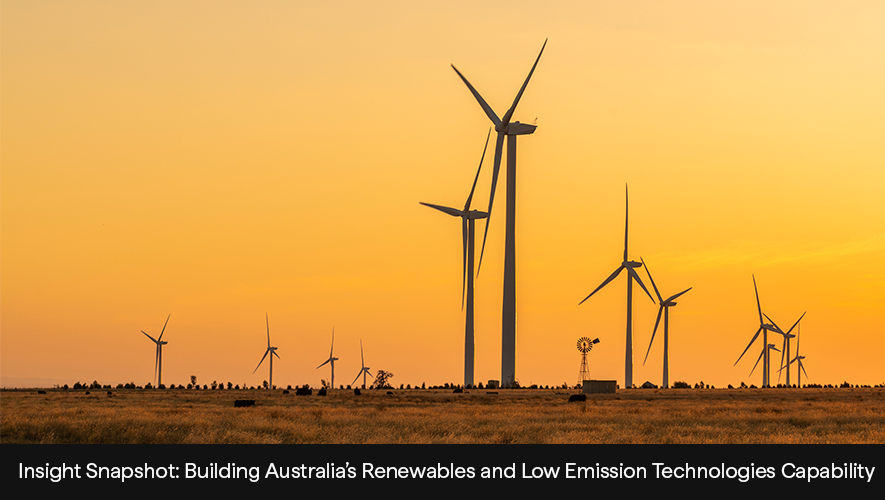
Australia’s energy system is transforming at pace. More households and businesses are generating electricity, storing it, and managing it with smart devices. Industry is steadily electrifying processes that were once powered by fossil fuels.
But delivering a reliable, affordable, low emissions energy system requires more than deploying new generation. It also requires the industrial and manufacturing capability behind the transition – the products, platforms, and enabling technologies that connect renewable energy to customers, lift efficiency, reduce emissions, and support more circular use of materials.
Renewables and Low Emission Technologies is one of the NRFC’s seven Priority Areas, selected by the Australian Government as areas where Australia has competitive advantages and an opportunity to be a global player. In this article, we explain what this Priority Area covers, why it matters to the national economy, and highlight how NRFC investment is supporting Australia’s energy transition.
Additionally, the recently announced $5 billion Net Zero Fund within the NRF(Opens in a new tab/window) provides highly concessional finance to decarbonise energy‑intensive industry, scale low emissions manufacturing, and crowd in private investment. It will be the subject of a later article.
What does renewables and low emission technologies cover?
This Priority Area is about the parts of the economy that manufacture products used in or that are connected to the energy transition and a lower emission, more circular economy.
In practical terms, it spans manufactured technologies and systems that help Australia:
- generate, transmit, distribute, and store renewable energy, and operate the grid safely and efficiently as the energy mix changes
- reduce greenhouse gas emissions through low emissions equipment and solutions deployed in the real economy
- lift energy efficiency, helping households and industry do more with less energy
- strengthen circular economy outcomes, including recycling, waste reduction, and recovering value from materials.
As with other NRFC Priority Areas, the focus is on investments that build sovereign capability, strengthen supply chains, and create high-value jobs, anchoring more of the value chain in Australia.
Why it matters for Australia
A reliable, affordable, low emissions energy system is now a core economic capability. It underpins productivity, industrial competitiveness, and regional development to strengthen national resilience by reducing exposure to fragile global supply chains.
This is consistent with themes across other NRFC Priority Areas. Whether it’s Defence Capability, Medical Science, or Value-add in Resources, the case for sovereign capability is the same: resilience, security, productivity, and high value jobs.
For Renewables and Low Emission Technologies, the opportunity is especially significant because the energy transition is a whole-of-economy transformation. It creates demand for new manufactured products, new energy services, and new ways of managing infrastructure at scale to reward countries that can build, integrate, and export those capabilities.
The growth opportunity
Australia gets a significant proportion of its electricity from renewables, with 51% of overall supply coming from wind, solar, and storage in the final three months of 2025.[1] However, with the Australian Government setting a target of 82% of grid electricity coming from renewables by 2030, there is still significant demand for the equipment and components needed in Australia’s energy transition.
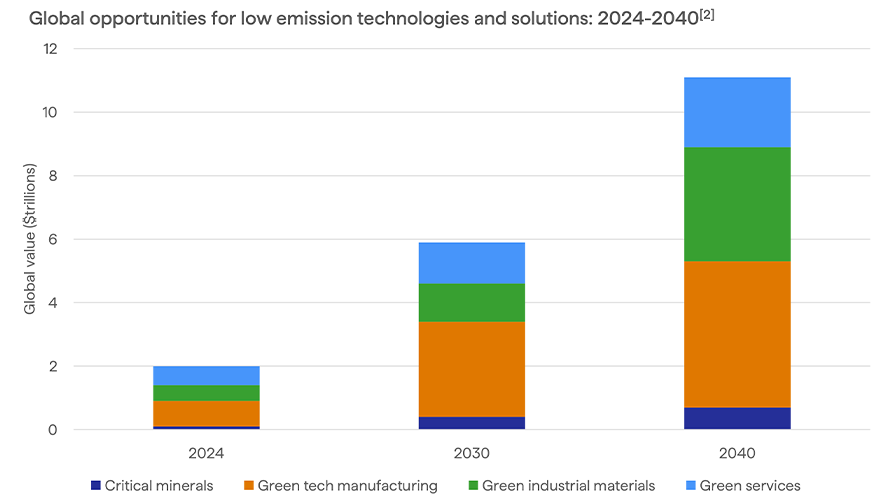
In addition, there is an enormous global opportunity for low emission technologies as countries look to achieve the goal of net zero by 2050, with the global value of green manufacturing, industries, and materials expected to increase from $2 trillion in 2024 to over $11 trillion by 2040.
Australia already has strong foundations to seize this opportunity: deep engineering capability, world-class research, and a growing ecosystem of energy and technology businesses. The challenge and opportunity is to scale manufacturing and deployment-ready capability so that more of the value from the transition is captured onshore.
Across the Insight Snapshot series, the growth opportunity is framed as closing the gap between innovation and scale: helping Australian firms commercialise, expand capacity, and compete in global markets with patient, strategic capital. The same logic applies here. Clean energy systems increasingly rely on integrated hardware and software, smart devices, data platforms, orchestration tools, and grid support products. The winners will be those who can manufacture, deploy, and improve those solutions at scale.
What does success look like?
- Stronger sovereign capability to manufacture products that enable renewable generation, storage, and efficient energy use.
- More resilient supply chains, reducing reliance on imported components and single point vulnerabilities.
- High skilled jobs growth, including in regional communities, across manufacturing, deployment, software, and analytics.
- Commercialisation of Australian innovation, translating R&D partnerships into real-world deployment and export pathways.
- Greater circular economy capacity, with stronger recycling, waste reduction, and resource recovery capability embedded in industrial systems.
What’s next?
NRFC investment is designed to support scalable projects that build sovereign capability and deliver durable economic benefits. In Renewables and Low Emission Technologies, that means engaging with businesses and proponents that can manufacture and scale the products that enable renewable energy systems, reduce emissions, lift efficiency, and strengthen circular economy outcomes.
Future articles will take a closer look at emerging areas within this Priority Area and the types of projects the NRFC is seeking to support, alongside additional case studies highlighting jobs created, partnerships formed, and regional impacts delivered.
NRFC investment case study
Intellihub
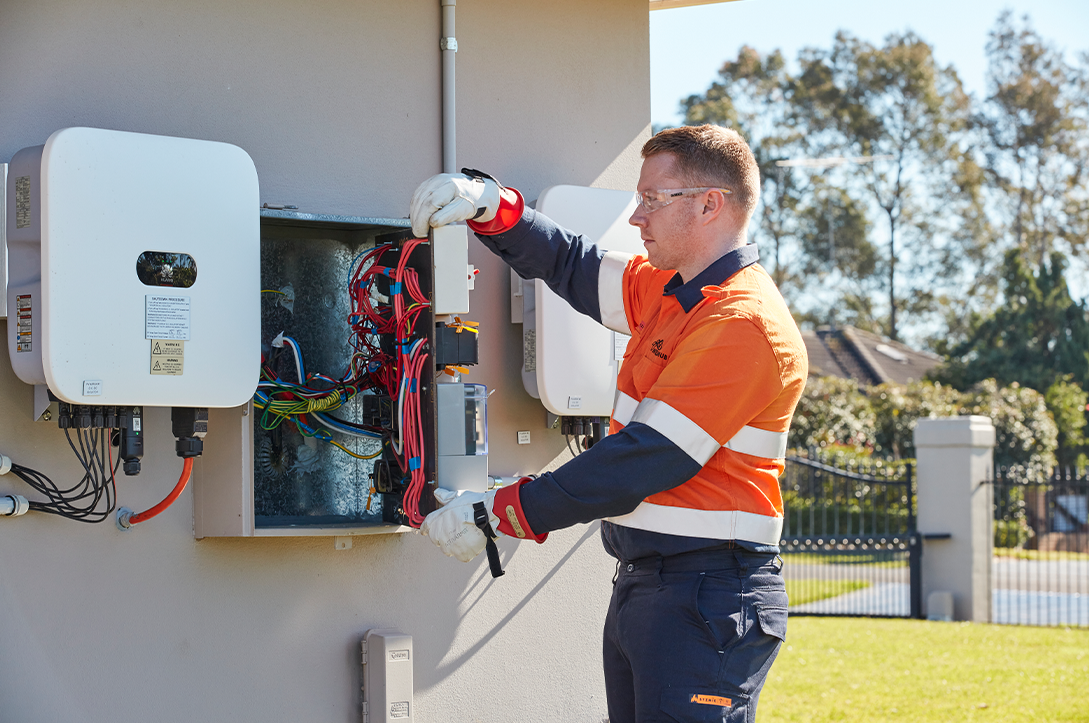
The NRFC’s $100 million investment in Intellihub – an Australian energy management company working to accelerate the rollout of a smarter, more connected electricity grid – is supporting the rollout of smart meters and upgrades to Intellihub’s Evergen energy management software, including broader integration with smart home devices.
Get in touch
Do you have an investment-ready proposal aligned to the Renewables and Low Emission Technologies Priority Area? Read our investment guidance and then contact the NRFC to discuss whether your project is eligible for funding and how we can work together to build Australia’s low emissions industrial capability.
[1] Australian Energy Market Operator, Quarterly Energy Dynamics Q4 2025, January 2026, https://www.aemo.com.au/-/media/files/major-publications/qed/2025/qed-q4-2025.pdf?rev=b29ae0bd014c48f59a259009d246280f&sc_lang=en(Opens in a new tab/window)
[2] Boston Consulting Group, Economic Growth Opportunities in a Greening World, January 2025, https://www.bcg.com/publications/2025/economic-growth-opportunities-greening-world(Opens in a new tab/window)