

Investment guidance at a glance
- The National Reconstruction Fund Corporation (NRFC) was established to transform and diversify Australia’s industry and economy, strengthen sovereign capability, and accelerate the transition to net zero.
- The NRFC invests through the General Portfolio, and three sub-funds established under the 2026 Investment Mandate(Opens in a new tab/window). These sub-funds include the:
- Net Zero Fund (NZF)
- Economic Resilience Program (ERP)
- Forestry Growth Fund (FGF).
- The NRFC may provide:
- Debt
- Equity
- Guarantees.
- The NRFC takes a medium to long term outlook when making investment decisions.
- The NRFC targets:
- General Portfolio benchmark returns of 5-year Australian Government Bond +2-3%; and
- Net Zero Fund and Forestry Growth Fund benchmark returns of the 5-year
Australian Government Bond -1%. - ERP does not have a benchmark and provides zero interest rate loans.
- The NRFC invests across eight Priority Areas, as defined in the National Reconstruction Fund Corporation (Priority Areas) Declaration 2026:(Opens in a new tab/window)
- Renewables & Low-Emission Technologies
- Enabling Capabilities
- Defence
- Transport
- Value-add in Resources
- Value-add in Agriculture, Forestry & Fisheries
- Medical Science
- Industrial Manufacturing & Critical Supply Chains.
- The NRFC cannot provide grants, directly finance coal extraction, natural gas extraction, construction of pipeline infrastructure for those activities, or native forest logging.
- This guidance outlines our investment requirements and process. It is not an investment policy for the purposes of section 75 of the National Reconstruction Fund Corporation Act 2023(Opens in a new tab/window) (the NRFC Act).
Eligibility
The NRFC considers opportunities consistent with the NRFC Act 2023(Opens in a new tab/window), the Investment Mandate Direction 2026(Opens in a new tab/window), and the Priority Areas Declaration 2026(Opens in a new tab/window).
Eligible proposals must:
- be solely or mainly Australian-based, or demonstrate a clear and material Australian nexus;
- align with at least one Priority Area;
- not be a prohibited investment;
- demonstrate a risk/return profile consistent with the Mandate and the relevant portfolio or sub-fund;
- reflect investee companies undertaking constitutionally supported activities for both debt to trust and equity investments, and;
- provide an Australian Industry Participation (AIP) plan where required.
General Portfolio & Sub-Funds
Proposals can be assessed for eligibility under the General Portfolio and/or under one of three sub-funds.
- General Portfolio
- Net Zero Fund (NZF) supports industrial decarbonisation, renewables & low-emissions manufacturing, electrification, energy-efficiency upgrades, and technologies that materially contribute to Australia’s net-zero transition.
- Economic Resilience Program (ERP) supports manufacturing and logistics businesses that strengthen Australia’s strategic and economic resilience, including through supply chain localisation, redundancy, and capability uplift.
- Forestry Growth Fund (FGF) supports value-add, innovation, processing, engineered wood product manufacturing, and regional & advanced forestry capability, consistent with sustainable forestry principles.
Investment criteria
Returns
The NRFC targets a General Portfolio return of 5-year AGS +2–3% and an NZF and FGF return of 5-year AGS -1% over the medium to long term.
Individual investments may have different risk/return profiles, including concessional features where explicitly permitted under the Mandate.
Risk appetite
The NRFC will:
- Take a medium- to long-term outlook.
- Consider higher-risk investments where they:
- support emerging technologies;
- strengthen sovereign capability;
- improve economic or strategic resilience;
- support industrial decarbonisation, and / or;
- have long-duration payback periods.
Risk evaluation includes:
- Financial and commercial risk;
- Technology and execution risk;
- ESG and climate-related risk;
- Reputational risk (explicitly required under the 2026 Mandate), and;
- Compliance with labour, safety, and environmental standards.
Policy outcomes
NRFC investments must have regard to the policy outcomes in the NRFC Act and the 2026 Investment Mandate, including:
- Industrial capability;
- Value-adding opportunities;
- Economic diversity;
- Crowding-in private capital;
- Decarbonisation and net-zero alignment;
- Secure jobs and workforce development;
- Supply chain resilience;
- Commercialisation of Australian IP;
- Economic participation by under-represented groups;
- Circular economy and sustainability;
- Regional development, and;
- National security.
Manufacturing Definition (Priority Areas Declaration 2026)
The Priority Areas Declaration defines manufacturing broadly to include:
- Developing products;
- Producing products;
- Assembling products;
- Installing products;
- Maintaining products;
- Providing logistics;
- Distributing products;
- Selling products;
- Storing products, and;
- Providing aftermarket services.
Where ‘products’ include equipment, components, software and technologies.
The NRFC investment process
The NRFC has a disciplined, repeatable, scalable and transparent Investment Process which is followed for all investments.
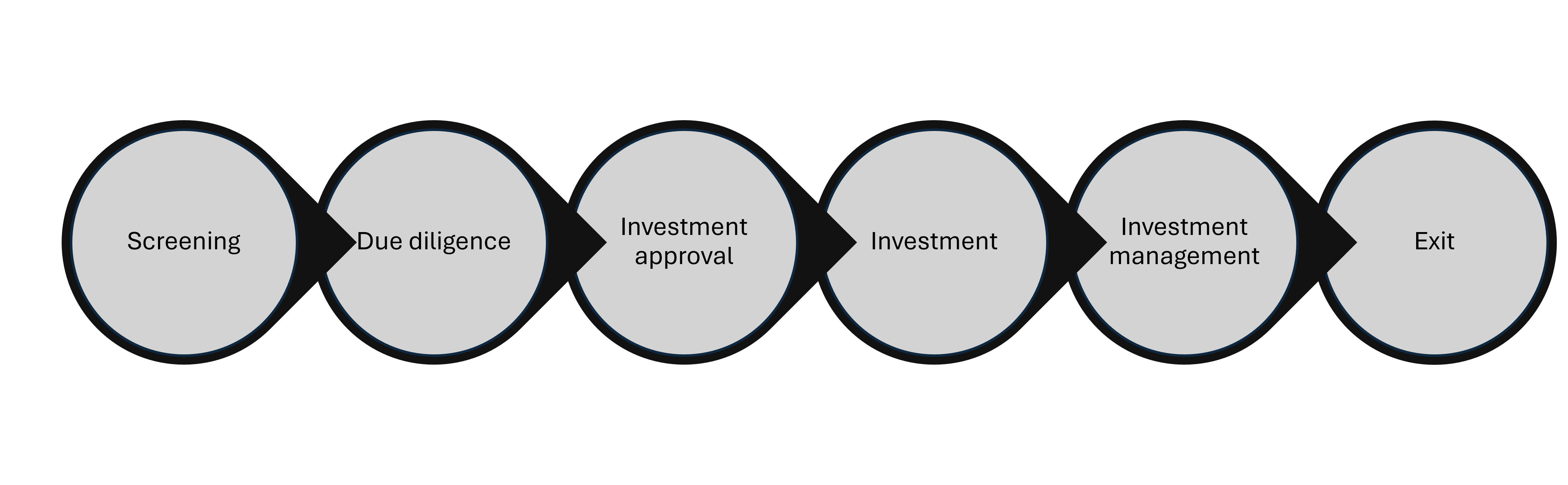
Investment proposals progress through various stages and key decision points of the Investment Process. If successful, the proposal is approved, executed and proceeds to ongoing investment management. The key stages of the Investment Process are:
Screening – initial pre-screening of proposals with respect to eligibility and alignment with Act and Mandate.
Due Diligence – three phases (with increasing levels of detail) of evidence based due diligence considering the following factors:
- Financial fit: Do the economics and return profile of the investment opportunity meet the NRFC’s investment parameters and support the relevant fund or sub-fund benchmark return requirement? Is the return timeframe consistent with the Mandate? Is the valuation reasonable (equity) or credit quality satisfactory (debt)?
- Commercial fit: Is the transaction suitably developed and does it have appropriate and capable management and relationships in place to ensure execution? Is investment readiness adequate? Is there a clear pathway to exit or liquidity event? Is the use of proceeds appropriate? Is the proposed business model scalable? Is the IP adequately protected?
- Technical Readiness: Has sufficient technology or project development been completed to provide confidence in the technical performance of the product or project to support the business case?
- Market fit: Is the product market large and accessible? Is there a strong product-market fit? Is there a clear competitive advantage and reasonable barrier to entry? Will the investment impact other market participants and the efficient operation of Australian financial markets?
- Impact fit: How does the investment support public policy outcomes and perform against section 17 factors?
- Governance: Is there an experienced management team and evidence of operational and financial delivery? Does the business have robust governance and ESG practices?
- Risk Tolerance: Are the risks inherent in the transaction within the parameters of the organisation's approved risk appetite? Have identified risks been sufficiently mitigated to make them acceptable?
- Portfolio fit: We may add additional limits as we evolve, such as exposures to individual counterparties or a target debt / equity mix. We’ll consider other risk categories, including construction risk and the level of commercialisation.
Investment Approval – review of investment at Investment Committee and ‘approval to invest’ granted (per DOA) for successful proposals.
Investment – commercial & financial close to execute investment and announce.
Investment Management – ongoing monitoring and management of the investment over its lifecycle including development of investment management plans, routine investment reviews & valuations and portfolio management.
Exit – exit investment (i.e. equity) or repay loan (i.e. debt) to realise investment returns.
NRFC Commitments
Throughout the Investment Process, the NRFC commits to:
- Working collaboratively with businesses;
- Communicate clearly about requirements;
- Respecting confidentiality;
- Act with professionalism and integrity at all times, and;
- Ensuring investments do not damage the Commonwealth’s reputation as required under the Act & Mandate.
Next steps
- Contact us via our website for more information
- Use our online form to share your investment proposal with the NRFC